

You Don't Need Just a Product, You Need a System
When many people purchase senior bathroom aids for the first time, they start by looking for a shower chair. This starting point is correct, but it easily leads to the misconception that choosing a single chair solves the entire problem.
In reality, bathroom falls are almost never caused by a single factor. Slippery floors, sudden standing, shifting center of gravity, and obstructed vision——these risks often occur simultaneously. A single shower chair only solves stability while "sitting down to bathe," leaving the entire pathway from entering the bathroom, crossing thresholds, to reaching the chair completely unprotected.
This is why, after serving global clients for over 50 years, our conclusion is that an effective bathroom safety solution centers on system integration, not standalone product selection. Four categories of core assistive devices each shoulder distinct structural functions:
Shower Chair / Bath Chair
Stable support for seated bathing, suitable for those unable to stand for long periods.
Bathtub Transfer Bench
Spans the inside and outside of the tub, allowing users to slide in safely while seated without lifting legs across.
Senior Grab Bars
Continuous support for bathroom safety, covering the entire movement path of entering, exiting, and standing up.
Transfer Assistance Tools
Swivel chairs, step stools——used for caregiver assistance to reduce occupational injuries among nursing staff.
Any procurement decision should simultaneously confirm three things: User mobility (can they stand, cross, and maintain balance independently?), Environmental space conditions (bathroom size, tub height, flooring material), and Structural safety standards (load capacity, certification requirements, legal liability). Missing any of these may result in purchasing a product that "looks safe" but fails to solve the real problem.

Three-Tier Mobility Classification: The Core Framework for Procurement Decisions
Bathroom safety is not as broad as "older adults should just install grab bars." Depending on a user's mobility status, the required assistive device configurations vary significantly. Through our experience serving international clients, we have developed a three-tier classification framework as the starting point for all procurement recommendations.
| Mobility Tier | User Characteristics | Recommended Configuration | Risk Control Focus |
|---|---|---|---|
| Level 1 Independent but Unsteady | Can walk independently, but feels insecure on slippery surfaces or when transitioning to a standing position. | Shower chair Anti-slip grab bars | Center of gravity shift during the standing transition. The focus is on strengthening grip points, not restricting movement. |
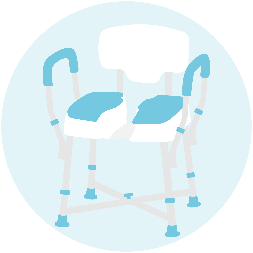
| Level 2 Limited Strength & Balance | Unable to stand for long periods; requires back support to stabilize the torso while seated. | Shower chair with backrest & armrests Wall-mounted safety grab bars | Sitting falls caused by exhaustion or dizziness. Multiple support points are required. |
| Level 3 Requires Assistance or Transfer Support | Lower limb weakness, unable to cross the bathtub edge independently, requires high-level caregiver assistance. | Transfer bench Multi-angle grab bars Swivel chair Bathroom step stool | Unbalanced single-leg suspension when entering/exiting the tub. The core is "seated entry and exit," eliminating the highest-risk motion. |
Environmental Risk Factors: What to Assess Before Choosing Products
Based on our field collaborations with international clients, the highest-risk bathrooms typically share several common characteristics——and blind spots easily overlooked when "selecting products solely from catalog specs":
- High-threshold bathtubs: A 40 to 50 cm crossing height poses a real threat to mobility-restricted seniors.
- Smooth tile surfaces: Without anti-slip treatment, combined with soap foam, the friction coefficient can drop to dangerous levels.
- Narrow layouts: Restricts the placement angles of safety equipment and affects maneuvering space for caregivers.
- Incorrect leverage habits: Users often unconsciously grab towel racks or basin edges, but these fixtures are entirely unsuited to bear human weight; secondary injuries caused by detachment are even more severe.
- Improper accessory placement: Shampoo placed too high causes seniors to overreach on slippery floors, easily triggering orthostatic hypotension or loss of balance.
Corresponding solutions: Step stool + bathtub grab bar + long shower chair to resolve high-threshold issues; apply anti-slip stickers or anti-slip agents to floors; choose foldable shower chairs for spatial limitations; purchase multifunctional grab bars with storage to reduce improper leverage at the root.
Equipment Definitions and Selection Standards: Beyond Basic Terminology
Many procurement parties use "shower chair," "bath stool," and "bathtub transfer bench" interchangeably. From an engineering perspective, the structural functions of these three devices are completely different, and mixing them up leads to incorrect purchasing.
Shower Chair
Designed to provide stable seated support in wet environments. Visually they may look similar, but the engineering gap can be substantial. Four dimensions that truly matter during selection:
- Frame material: Anodized aluminum alloy is the standard choice, being lightweight and oxidation-resistant, forming a dense protective film on the surface to eliminate corrosion. Compared to steel, it is 30% to 40% lighter, making it more suitable for long-term care environments.
- Seat anti-slip: Must feature fine texturing (knurling/embossing) to increase the friction coefficient between skin and plastic, maintaining grip even with soap foam. Drainage hole design directly affects whether accumulated water creates a "hydroplaning effect" causing slips.
- Load capacity: Basic models typically claim 250 lbs (113 kg). Static load testing requires 1.5 to 2 times the nominal value; a product rated for 250 lbs must actually pass testing up to 375 to 500 lbs to qualify. Shih Kuo's ultra-high load capacity model reaches 500 lbs (227 kg).
- Tip/ferrule material: TPR tips provide anti-slip traction, directly affecting stability on wet floors.
Bathtub Transfer Bench
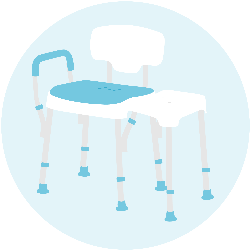
This is not just a larger shower chair, but a completely different functional design. The core logic is: let the user "sit down first, then move," fundamentally eliminating the moment of single-leg tub-crossing with the highest fall rate.
Bathtub edges are typically 40 to 50 cm high. For seniors with hip joint injuries, strokes, or insufficient muscle strength, this height is not an inconvenience—it's a safety threat. The existence of a transfer bench completely removes "having to step across" from the user's task list.
— MedGear Product R&D Team| Functional Feature | Standard Shower Chair | Bathtub Transfer Bench |
|---|---|---|
| Primary Positioning | Stable seated bathing | Bridge transfer between inside and outside of the tub |
| Core Benefit | Anti-slip, reduces standing burden | Eliminates crossing obstacles, prevents transfer tipping |
| Structural Traits | Lightweight, space-saving | High-rigidity frame, maximum support area |
| Target Users | Those who can step into the tub independently but have unstable standing | Those unable to step into the tub or with extremely poor balance |
| Caregiver Operation | Mostly operated independently by the user | Supports caregiver assistance, reducing lower back occupational injuries for nursing staff |
Bath Stool
A minimalist support solution offering small footprint and high mobility. However, in B2B or medical procurement scenarios, we recommend asking one question first: Can the user stand up independently from a chair without armrests? If yes, a bath stool is sufficient. If the answer is uncertain, you should upgrade to a model with a backrest and armrests.
Lack of a backrest means the user must continuously engage back muscles to maintain an upright posture. For patients in early recovery, a bath stool is only suitable as a "temporary resting tool during showering," not a full-course seated bathing solution. We strongly recommend pairing it with wall grab bars.
Why Grab Bars Are Essential Bathroom Equipment, Not Optional Accessories
Grab bars are not "things you install only when you get old"; they are fundamental safety facilities for any wet environment. According to long-term studies by the US CDC and WHO, bathrooms consistently rank among the top three danger zones for home falls among older adults. Seniors often suffer from osteoporosis, and a single fall can easily trigger a hip fracture, frequently turning into a turning point of declining health.
Physiologically, a senior's balance declines with age. When closing eyes to wash hair or turning around to retrieve items, vestibular sluggishness can easily trigger momentary dizziness. Rising after a hot bath causes orthostatic hypotension due to temperature differences, one of the most common causes of loss of consciousness in bathrooms. In these scenarios, having a solid grip point nearby can make a world of difference.
Safety Grab Bar Layout: Functions by Area
| Installation Area | Safety Function Description | Recommended Type |
|---|---|---|
| Toilet Area | Reduces knee joint stress and prevents orthostatic dizziness caused by rising too quickly. Dual-sided configuration is recommended for maximum stability. | L-shaped grab bar, fold-up bar, dual toilet grab rails |
| Washbasin | Prevents accidental grabbing of ceramic basin edges when leaning forward, providing front support during face washing and brushing. | U-shaped wrap-around bar, basin-dedicated grab bar |
| Shower Area | The third support point when washing hair or when soap foam is on the floor, ensuring the center of gravity remains steady. | Straight bar, multi-angle combination bar |
| Bathtub Area | Resolves the imbalance risk of single-leg suspension during entry/exit, assists seated rising, and prevents getting trapped in the tub. | Bathtub rim-mounted grab bar, wall-mounted grab bar |
| Doorway Pathway | Balance point for threshold height differences, implementing the principle of "grab steady before stepping off." | Vertical wall-mounted straight grab bar |
"Being able to use the toilet independently" is the baseline of dignity. Comprehensive grab bar configurations allow seniors to enter and exit without constant family assistance, providing psychological liberation for both caregivers and care recipients.
Procurement Combination Strategy: Why "Buying Just One" Carries Risks
The most common mistake we observe when serving distributor channels is purchasing only a single item——such as buying only a shower chair without integrating grab bars or transfer equipment. This fragmented setup creates a fatal "false sense of security": the shower chair only solves stability while sitting, while the entire transfer process of entering the bathroom and crossing thresholds remains completely unprotected.
For medical and long-term care facilities, an incomplete safety plan that results in an accident immediately brings legal liability issues to the surface.
Recommended Configurations for Three Scenarios
Independent Seniors
Self-care is unimpeded, requiring only basic protection
Reduce fatigue from prolonged standing, provide balance points for entering/exiting wet areas, and maintain the dignity of independent bathing.
Moderately Assisted Users
Declining balance, insufficient lower limb strength
Shower chair armrests assist sitting down and standing up, while wall grab bars protect the transfer process, forming an all-around support ring.
High-Risk / Care-Dependent Users
Severe muscle atrophy, requires assistance during bathing
Transfer bench eliminates crossing hazards, swivel chair allows caregivers to move users without chair obstruction, enabling rotation to different bathing angles without standing.
Materials, Testing, and Certifications: Standards for Choosing a Reliable Manufacturer
For global B2B buyers, compliance is not optional——it directly determines whether you can enter the market and who is held responsible if something goes wrong.
Three Key Testing Standards
- Static Load Test: According to US ADA and EU EN 12182 standards, products must withstand a continuous load of at least 250 lbs (approx. 113 kg) without deformation. Shih Kuo adopts a 1.5 safety factor; products rated for 500 lbs undergo actual laboratory application of 750 lbs continuous load, and the structure must show no cracks or permanent deformation.
- Salt Spray Corrosion Resistance Test: Placed in a high-concentration salt spray environment for hundreds of hours, the surface must not rust, blister, or peel. Long-term bathroom moisture combined with detergent splashes can cause rust-induced structural embrittlement, directly reducing safety performance rather than just appearance.
- Cyclic Fatigue Test: Simulating rising motions, pressure is repeatedly applied over 100,000 times without loosening, deforming, or breaking structures. This ensures the product remains as solid after 5 or 10 years as it was on day one.
Shih Kuo's Material Standards
- Anodized Aluminum Alloy Frame: Forms a dense protective oxide film on the surface, fundamentally eliminating corrosion while weighing 30% to 40% less than steel.
- Stainless Steel Screws: All critical connection parts use stainless steel screws, preventing rust spots or structural embrittlement even in prolonged water vapor exposure.
- Japan SIAA Certified Antibacterial Processing: PP/PE materials incorporate SIAA-certified antibacterial technology, actively inhibiting bacterial growth in high-humidity bathroom environments to protect senior skin health.
Global Market Certifications
MedGear Solutions vs. Traditional Procurement: Comprehensive Comparison
We do not design products merely for catalog display. The real difference lies in the details:
| Key Area | Evaluation Metric | Traditional Single Procurement | Shih Kuo Standard Combination Strategy | Commercial & Safety Value |
|---|---|---|---|---|
| Product Configuration | Protection Completeness | Purchasing only a shower chair, ignoring transfer pathways | Scenario-based combination: Shower chair + grab bars + transfer bench | Eliminates "false security," lowers fall risks |
| Structural Safety | Ultimate Load Capacity | Standard 250 lbs (113 kg) | Advanced 500 lbs (227 kg), 1.5x safety factor | Covers bariatric markets, adapts to broader user groups |
| Material Craftsmanship | Corrosion Resistance | Anodized aluminum + galvanized screws | Anodized aluminum + stainless steel screws | Long-term stability in hot/humid environments without embrittlement |
| Hygiene Protection | Bacterial Defense | No special requirements, prone to mold | Japan SIAA certified antibacterial processing (PP/PE) | Active defense, suitable for immunocompromised seniors |
| Assembly Experience | Convenience | Requires tools, cumbersome parts | 100% Tool-Free design | Reduces assembly difficulty and after-sales complaints |
| Quality Verification | Testing Intensity | Unverified by data or basic random sampling | In-house laboratory: Load, salt spray, impact, 100k+ cycles | Every product backed by complete test data |
| Compliance Assurance | Global Access | Incomplete certifications, high market risk | FDA + CE/MDR + USD 1M liability insurance | Meets national regulatory thresholds, shifts procurement risk |
| Customization | OEM Flexibility | Rigid specs, low brand recognition | Deep customization of structure, color, material, packaging | Helps partners build own-brand competitiveness |
Frequently Asked Questions (FAQ)
Start a Global Protective Strategic Partnership Today
If you are looking for globally competitive, low-legal-risk bathroom safety solutions for your market, the MedGear professional team is ready to provide comprehensive support.